
Digital Marketing for Physical Therapy Clinics: Where To Spend
Most clinics that feel like their marketing "isn't working" haven't picked the wrong channel. They've spread a small budget across too many channels at once - a little on Google Ads, a little on Facebook, a little on SEO, maybe a flyer at the gym down the street - and none of it gets enough behind it to actually produce results. The real question isn't "which channel is best." It's "in what order, and how much."
How much to actually budget
The most practical framework is a percentage of gross revenue. For an established cash-pay clinic, we recommend 7-10% per month: 7-8% for steady, moderate growth, and up to 10% when you're pushing for aggressive expansion. That range is grounded in real spending data. A U.S. Small Business Administration article on marketing budgets cites research showing average marketing spending of 7.9% of revenue, with business-to-consumer service companies - the category a physical therapy clinic falls into - spending considerably more, at 11.8%. So a 7-10% budget isn't aggressive for a clinic. If anything, it's on the conservative side of what similar businesses spend.
Here's what that looks like in practice. Take a hypothetical clinic doing about $1 million a year, or roughly $83,000 a month. At 8% for moderate growth, that's about $6,640 a month for marketing. At 10%, it's about $8,300. Run the same math on your own monthly revenue before you look at any proposal - it gives you a number to plan against instead of reacting to whatever an agency quotes.
If you're a brand-new practice without enough revenue history to calculate a meaningful percentage, use a floor instead: plan on $500 to $1,000 a month in ad spend per location as a starting point, separate from anything you're paying an agency or a platform. Underspending is the far more common mistake - clinics that treat marketing as an occasional expense instead of a real monthly line item are usually the ones wondering why growth has stalled.
Where the budget actually goes
A marketing budget isn't one number - it's usually three. Keeping them separate makes it much easier to see what's working:
■Ad spend - the money that goes directly to Google or Meta to show your ads.
■Management and creative - what you pay an agency, freelancer, or staff member to build and run the campaigns.
■Tools - software like your CRM, booking system, and texting, which tend to be smaller, fixed monthly costs.
When a proposal gives you a single bundled number, ask for it broken into these three parts. It's the only way to know how much of your budget is actually reaching potential patients.
The five stages at a glance
Stage | Main goal | Move on when |
1. Foundation | Complete Google Business Profile and condition pages | Both are live, accurate, and have a clear next step |
2. Paid traffic | Booked evaluations within days | Campaigns are producing evaluations at a cost you can sustain |
3. SEO and content | Traffic that keeps coming without ongoing ad spend | Priority pages are ranking and bringing in leads |
4. Fix the leaks | More bookings from the traffic you already have | Follow-up and reviews run automatically and consistently |
5. Scale | Grow what's already proven | Ongoing - add one new avatar or channel at a time |
Stage 1: the free and near-free foundation, first
Before spending real money anywhere, get the parts that cost time rather than dollars in place: a fully completed Google Business Profile and a website with a dedicated page per condition instead of one generic services page. Both of these are covered in full in the SEO guide - the short version here is that skipping this step and going straight to paid ads means paying to send traffic to a foundation that isn't ready to convert it.
Stage 2: paid traffic, for cash flow you can measure in days
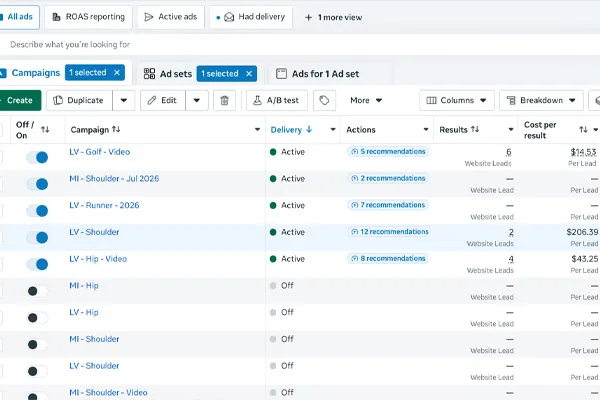
Once the foundation is in place, paid traffic is usually the right next dollar, especially for a newer or cash-constrained clinic, because it's the one channel that can produce booked evaluations within days rather than months. This is where the ad-spend floor above actually gets spent - and where splitting the budget by patient avatar instead of running one generic campaign matters most, since the numbers from a real campaign built this way show how much of a difference that split makes at the same spend level.
Why the $500-1,000 floor matters, rather than "start small and see": clicks aren't cheap. In LocaliQ's 2026 search advertising benchmarks, the average cost per click was $4.76 for physicians and surgeons and $6.17 for health and fitness. At roughly $5 a click, a $500 monthly budget buys about 100 clicks. Split across three patient avatars, that's only around 33 clicks each - barely enough to tell what's working. A budget spread thinner than that buys too few clicks to draw any real conclusion, and a clinic ends up guessing instead of learning.
Stage 3: SEO and content, the layer that compounds
SEO is slower than paid traffic - in our experience, measurable traction for a local clinic usually takes several months, and longer in competitive markets. That's exactly why it belongs after the foundation and alongside paid spend rather than instead of it. The payoff is that it keeps producing without ongoing ad spend once it's established, which gradually lowers how much you have to pay per new patient over time. Most clinics need both running at once eventually; the sequencing question is really about which one earns the next available dollar first, not which one wins permanently.
Stage 4: fix what you have before you add more spend
Once traffic is coming in from paid, SEO, or both, the highest-return next step is usually not a new channel - it's making sure you're not losing the traffic you're already paying for. A follow-up sequence for visitors who don't book on the spot, and reviews curated by objection rather than collected and forgotten, both cost far less than acquiring new traffic and directly increase what you get from the traffic you already have. Concretely, that means an SMS and email sequence that runs for at least a week or two after someone opts in without booking, not a single automated message the day they sign up. Many leads aren't ready to book the first time they hear from you, so the later messages in a sequence often do the real work.
This is also the stage where it's worth looking at cost per booked evaluation rather than cost per click or cost per lead alone. The math is simple: total marketing spend for the month divided by the number of evaluations booked from it. A cheap lead that never converts is more expensive than an expensive one that does - and Stage 4 is where that gap between the two usually gets closed, before any additional ad spend gets added on top.
Stage 5: scale what's already proven
Only once the earlier stages are functioning - foundation built, paid traffic converting, SEO gaining traction, follow-up plugging the leaks - does it make sense to add new patient avatars, formalize a professional referral network, or add channels like corporate partnerships. Adding these earlier just spreads an already-thin budget thinner. When you do scale, add one thing at a time and give it enough budget and time to prove itself before adding the next.
A quick way to place yourself
■Brand new, little to no revenue history: Stage 1 foundation plus the ad-spend floor. Nothing else yet.
■Established but growth has plateaued: confirm Stage 1 is actually complete (most plateaued clinics have gaps here they've stopped noticing), then check whether Stage 4's follow-up and review work is actually happening before adding budget anywhere.
■Growing and ready to push harder: Stage 5 - this is where the 10% aggressive-growth end of the budget range and new avatars or partnership channels actually make sense.
Frequently asked questions
Should I do SEO or paid ads first?
Paid ads first for cash flow, with the free foundation (Google Business Profile, condition pages) built in parallel since it costs time rather than budget. SEO content becomes the next dollar once paid traffic is converting reasonably well - not a replacement for paid, a layer added alongside it.
How much should a physical therapy clinic spend on marketing per month?
7-10% of gross revenue once you have revenue history to calculate from; a $500-1,000/mo ad-spend floor per location if you don't yet. See the budgeting section above for the full framework and a worked example.
Does the 7-10% include what I pay an agency?
Yes. The percentage covers your total marketing budget - ad spend, management, and tools together. The $500-1,000 floor for new clinics is different: that's ad spend alone, with management and tools on top.
What if paid ads aren't producing evaluations?
Before cutting the budget, check the steps after the click. Look at whether the landing page matches the ad, how quickly new leads are contacted, and whether a follow-up sequence is running. Very often the ads are fine and the leak is further down - which is exactly what the landing page opt-in guide covers.
Is local print advertising or a newspaper ad worth it for a physical therapy clinic?
Rarely, for cash-pay clinics specifically - print can't target by condition or objection the way digital can, and there's no reliable way to measure what it actually produced. The budget almost always does more work in one of the five stages above.
FREE AUDIT
Not sure which stage your clinic is actually in?
The free audit looks at your current marketing spend and tells you honestly whether the next dollar should go toward the foundation, paid traffic, SEO, or fixing the follow-up you already have.